Occupied Home Staging: How to Stage a Home You Still Live In
 David Sirera
 The short answer: occupied home staging means preparing a house for sale while you still live in it. You keep your furniture, pack away the personal and everyday items, clean, and set each room up so buyers can picture themselves there. Most of the work is decluttering, and it needs a daily routine so the house stays show-ready between viewings. If a room cannot be cleared in time for the listing photos, an AI tool such as RoomLab.app can remove the clutter from the photo while keeping the real furniture, as long as you check the result and the house matches it on viewing day. Below you will find a room-by-room plan, a real three-attempt test of photo decluttering on a lived-in living room, and where that approach stops being honest.
Key takeaways
- Declutter first, buy nothing: decluttering was the top improvement agents recommended to sellers (91%), ahead of cleaning (88%) and curb appeal (77%), in NAR's 2025 Profile of Home Staging.
- Start with the living room: it is the room agents stage most (91%) and the one buyers' agents rated most important to stage (37%).
- Photo decluttering is a backup, not a shortcut: in our test, none of three AI attempts was perfect. The best one cleared the room but added a small boxed item to a shelf, so every output needs a check.
- The photo must match the house: remove things that will be gone at the viewing, never permanent features or damage, and label edited photos.
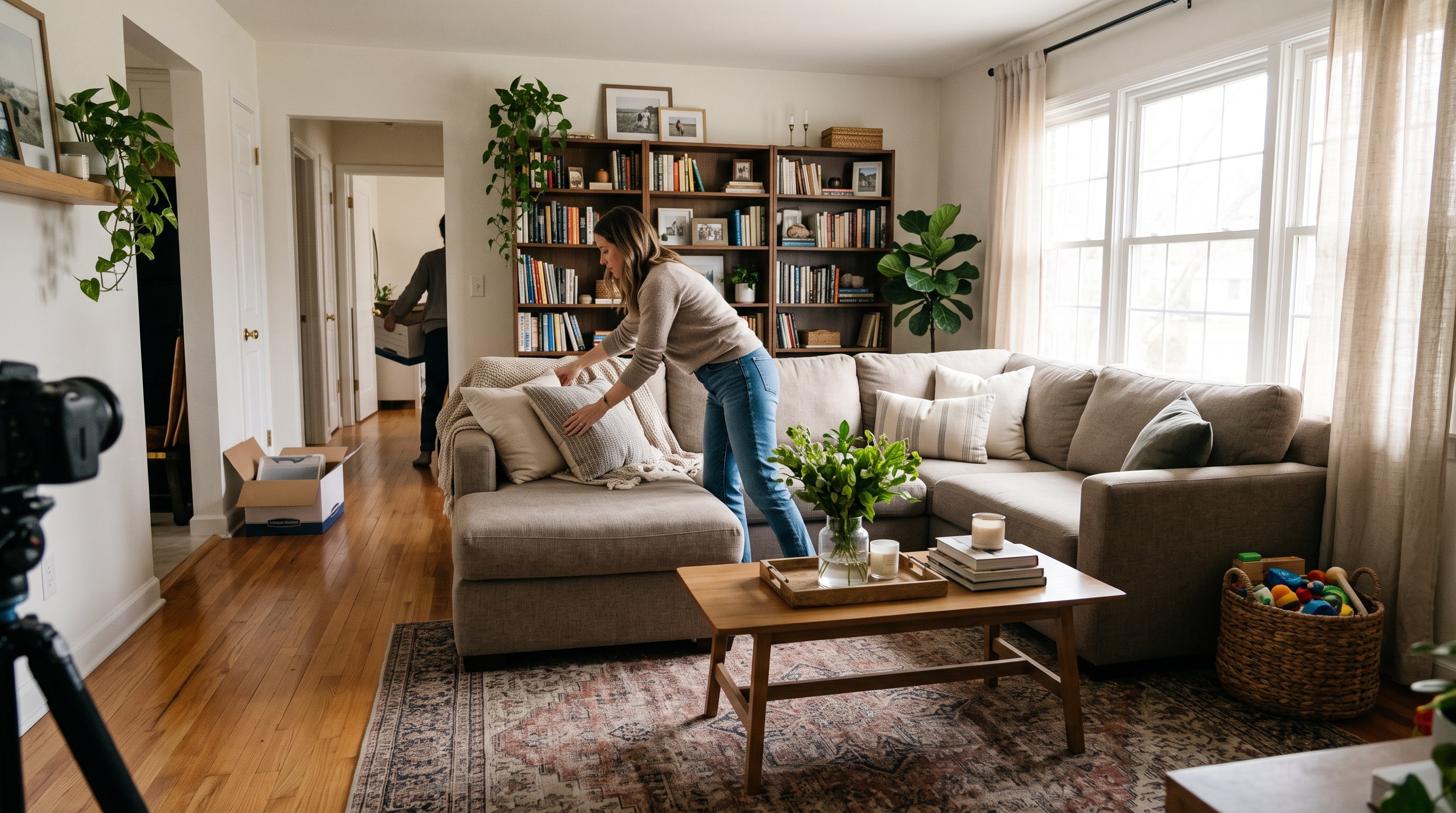
What is occupied home staging?
Occupied home staging is staging a house that the seller still lives in, using mostly the seller's own furniture. Vacant staging starts from empty rooms and brings everything in. Occupied staging works the other way: it takes things out, rearranges what stays, and adds only a few pieces where a room looks bare or tired. A professional stager often does it as a consultation, walking the house and leaving a list, and the seller does the work. Many sellers and agents do it themselves.
It is worth doing because people stop seeing their own home. "The typical home seller resides in their home for 10 years before selling," NAR's deputy chief economist Jessica Lautz said with the 2025 Profile of Home Staging, adding that in that time "homeowners might overlook certain aspects that could be less appealing to potential buyers" (Source, 2025). In the same survey of 1,266 Realtors, 83% of buyers' agents said staging made it easier for a buyer to picture the property as their future home, and 49% of sellers' agents saw staging reduce time on the market. Those are agents' views, not measured sale results, but they match what staging is for.
How do you stage a house while still living in it?
Work in three passes: remove, clean, then arrange. Spend nothing until the first two are done, because decluttering does most of the work. Agents agree on the order. Decluttering was the home improvement agents recommended to sellers most often, and more than half (51%) of sellers' agents did not stage homes at all but recommended that sellers "declutter or correct property faults" (NAR, 2025).
Pass 1: remove
Pack as if you have already sold. Anything you will not use in the next two months goes into boxes, and the boxes go to a garage corner, a storage unit or a relative's house, not into the closets buyers will open. Then take out the things that make a room read as yours rather than theirs:
- Personal items: family photos, kids' artwork, fridge magnets, school schedules, religious and political items, trophies and collections.
- Surface clutter: mail, chargers and cables, remotes, toiletries, small appliances on counters, piles of shoes by the door.
- Extra furniture: one chair too many, the exercise bike in the bedroom, the overflowing bookcase. A room with less furniture looks bigger in photos and is easier to walk through at a viewing.
- Half of what is in closets and cabinets. Buyers open them. Half-empty storage reads as plenty of storage.
Pass 2: clean and fix
Deep clean once, properly: windows, grout, baseboards, light fittings, carpets. Then fix the small faults a buyer will notice, such as dead bulbs, dripping taps, sticking doors and scuffed walls. These are the "property faults" agents tell sellers to correct, and no photo edit should hide them.
Pass 3: arrange, room by room
Start with the living room. It was the room agents staged most often (91%), and buyers' agents rated it the most important room to stage (37%), ahead of the primary bedroom (34%) and the kitchen (23%) (NAR, 2025).
- Living room: pull the sofa off the wall if the room allows it, clear the coffee table down to one object, hide cables, open the blinds. Keep two or three cushions and one throw, folded.
- Kitchen: clear the counters except one or two items, empty the sink and the drying rack, take everything off the fridge door.
- Primary bedroom: make the bed with plain bedding, clear both nightstands, put away clothes, including the chair that collects them.
- Kids' rooms: keep the bed and one storage unit, box most of the toys, take the art off the walls. Agents staged children's bedrooms least often (22%), so tidy beats styled here.
- Bathrooms: nothing on the counter or the edge of the tub, fresh white towels, the lid down.
Keeping the house show-ready while you live in it
With a fifteen-minute reset you can do before every viewing, and a place to put things fast. Most occupied listings fail here, not on the first day. What works for families:
- Keep a "showing bin" per person. One lidded basket each for the day's stuff: chargers, toys, mail, makeup. Before a viewing, the bins go in the car.
- Run the same checklist every time. Beds made, counters clear, sink empty, toilet lids down, blinds open, lights on, bins out.
- Plan for pets. Bowls, beds and litter trays out of sight, and the pet out of the house during viewings.
- Cook simple food while you are listed. Smells linger, and so do the pans.
- Leave for the viewing. Buyers look longer and talk more freely when the owners are not there.
What if the rooms cannot be cleared before the listing photos?
Then you can declutter the photo instead of the room, with a tool built for that job. A family with small children, a seller who works from home, or a photographer booked before the packing is done: in each case the listing photos can capture a mess the buyers will never see at a viewing. The Declutter Room tool in RoomLab.app removes loose clutter and personal items from a photo while keeping the furniture, appliances, lighting and architecture where they are. It is different from emptying the room: the buyer still sees the seller's real sofa and table, just without the mail and the laundry.
The condition is that the photo shows something true. Use it to remove things that will really be gone, or put away, when buyers walk in. If the clutter will still be there at the viewing, the photo sets up a disappointment.
Our test: one lived-in living room, three attempts
We made an example photo of an ordinary family living room: beige carpet, a gray sofa, a brick fireplace with family photos and kids' drawings on the mantel, a TV console with game controllers and cables, mail and mugs on the coffee table, a laundry basket, a backpack and sneakers on the floor. It is an example photo made for this test, not a customer's listing. We ran it three times with the same prompt that Declutter Room fills for room type Living Room, on the same image model, and kept every output unretouched. The app also rewrites the prompt before generating, which our test script does not, so results in the app can differ a little.
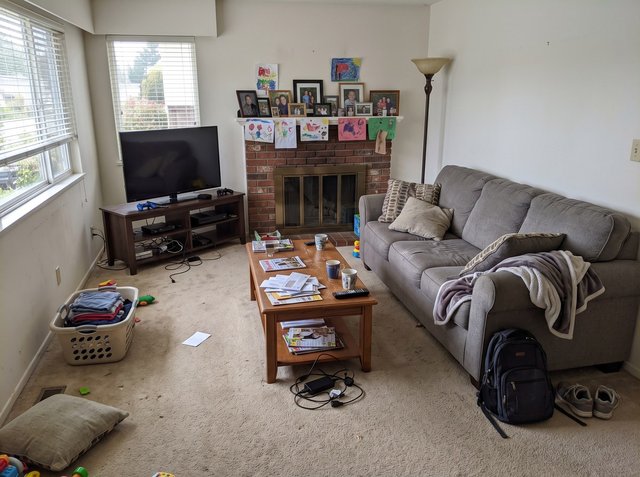
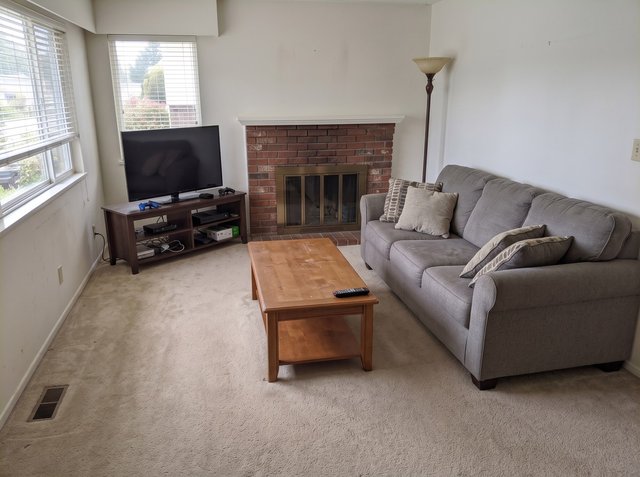
What held in attempt 2: the camera angle, both windows and their blinds, the fireplace, the floor lamp, the heating vent, the outlet and the light switch all match the original. The sofa, coffee table, TV and console stayed in place. The mail, mugs, charger, laundry basket, backpack, shoes, blanket, kids' drawings and family photos are gone, which is exactly what an occupied home staging checklist asks for. What did not: where the cables had been, a small white-and-green boxed item appeared on the lower console shelf. It is easy to miss and easy to fix with another attempt, or by putting a similar box there before the viewing, but it is not in the original room.
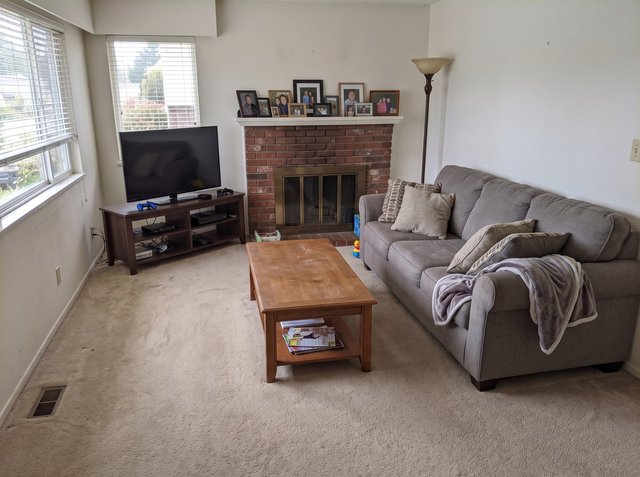
The limitation: attempt 1 cleared the floor and the table but left the row of family photos on the mantel and a toy on the hearth, the personal items a buyer should not see. Attempt 3, not shown, removed everything but then invented decor: vases and a clock on the mantel and a tray with a candle on the coffee table. None of the three was perfect. Notice also what no attempt changed: the scuffs on the left wall are still there, because the tool cleans a room, it does not repaint it.
One room is not a measured error rate, but the pattern is useful. Photo decluttering gets the big, obvious mess right and makes small mistakes at the edges: an item left behind, an item added. Compare every output with the original at full size, and budget two or three attempts per room. In RoomLab.app each attempt is one image generation, which costs 10 credits. Our example library has more pairs made the same way, including a cluttered kitchen and a kids' bedroom full of toys. If you want to compare tools, our roundup of AI room declutter apps covers the alternatives.
Declutter, empty or stage: which edit fits an occupied listing?
For most occupied listings, declutter, because the buyer will see the seller's furniture at the viewing and the photo should match. The other edits answer different problems:
| Situation | Tool | What the photo shows |
|---|---|---|
| Seller stays, furniture stays, the mess will be put away | Declutter Room | The real room on a tidy day |
| Seller is moving out and the furniture is leaving | Empty Room | The room as buyers will find it once vacant |
| The furniture is dated or does not fit the room | Virtual Staging after Empty Room | A suggestion of how the space could be furnished, labelled as staged |
| Buyers struggle to see past a dated style | Change Style | A redesign idea, shown next to the real photo, not instead of it |
The further the photo moves from the room as it will be on viewing day, the more clearly it needs a label. Agents who list occupied and vacant homes every month can see how these tools fit a listing workflow on our real estate staging page, and our comparison of virtual staging vs physical staging covers when hiring furniture is still worth it.
Do you have to disclose decluttered listing photos?
Label any photo that has been edited beyond normal color and exposure correction, and never remove anything that is part of the house. The NAR Code of Ethics requires Realtors to "present a true picture in their advertising, marketing, and other representations" (NAR Code of Ethics, 2025), so check your local MLS rules on edited photos too. A practical line:
- Fine to remove: things that leave with the seller or get put away, such as mail, toys, laundry, photos and small appliances.
- Never remove: cracks, stains, water damage, worn flooring, scuffed walls, a view of the neighbor's wall, power lines, or anything else a buyer would find on the visit.
- Always: add a short caption such as "digitally decluttered", keep the original photo, and check the edit has not changed a fixed feature.
Our guide to whether virtual staging is legal covers the disclosure rules in more detail.
How do you declutter a listing photo in RoomLab.app?
Five steps, the same checks we applied to our test:
- Take the photo as if the room were already staged. Daylight, all lights on, blinds open, camera at chest height from a corner. Clear what you can by hand first; the less the tool has to remove, the less it has to reconstruct.
- Open the RoomLab.app workspace, upload the photo, choose Declutter Room and set the room type.
- Compare the result with the original at full size. Check what was removed and what, if anything, was added. Personal photos and small items on shelves are the usual misses.
- Retry rather than settle. If something was left behind or invented, generate again. Two or three attempts per room is normal.
- Label it and keep the original, then make sure the room looks like the photo before the first viewing.
Frequently asked questions
Can you stage a house while living in it?
Yes. Occupied home staging uses your own furniture: you pack away personal and everyday items, deep clean, fix small faults, and arrange each room so it looks larger and calmer. The hard part is keeping it that way, which a daily reset routine and a basket per person for loose items make manageable.
What should you not do when staging an occupied home?
Do not hide boxes in closets buyers will open, do not leave family photos and personal items on display, do not buy new furniture before you have decluttered, and do not use photo edits to hide damage or permanent features. Buyers will see the real house at the viewing.
Is there an app that removes clutter from real estate photos?
Yes. RoomLab.app's Declutter Room tool removes loose clutter and personal items from a room photo while keeping the furniture and architecture in place. Check each result against the original, because AI tools sometimes leave an item behind or add a small one. Every new account gets one free image, no card required.
Which room matters most when staging an occupied home?
The living room. In NAR's 2025 Profile of Home Staging, it was the room agents staged most often (91%) and the one buyers' agents rated most important to stage (37%), followed by the primary bedroom and the kitchen.
The bottom line
Staging a home you still live in is mostly subtraction: pack early, clean once properly, fix the small faults, set up the living room first, and keep a fifteen-minute reset for every viewing. When the listing photos come before the packing, decluttering the photo is a reasonable backup, as long as you check every output, as our three attempts show, and the house matches the photo when buyers arrive. Your first RoomLab.app image is free, no card required, so you can try Declutter Room on your messiest room before the photographer comes.
Sources
- National Association of Realtors, NAR Report Reveals Home Staging Boosts Sale Prices and Reduces Time on Market (2025 Profile of Home Staging), May 6, 2025, retrieved 2026-10-16.
- National Association of Realtors, 2025 Code of Ethics and Standards of Practice, Article 12, retrieved 2026-10-09.
Ready to Transform Your Space?
Start creating stunning room transformations in minutes. Sign up and try it yourself!
More Articles
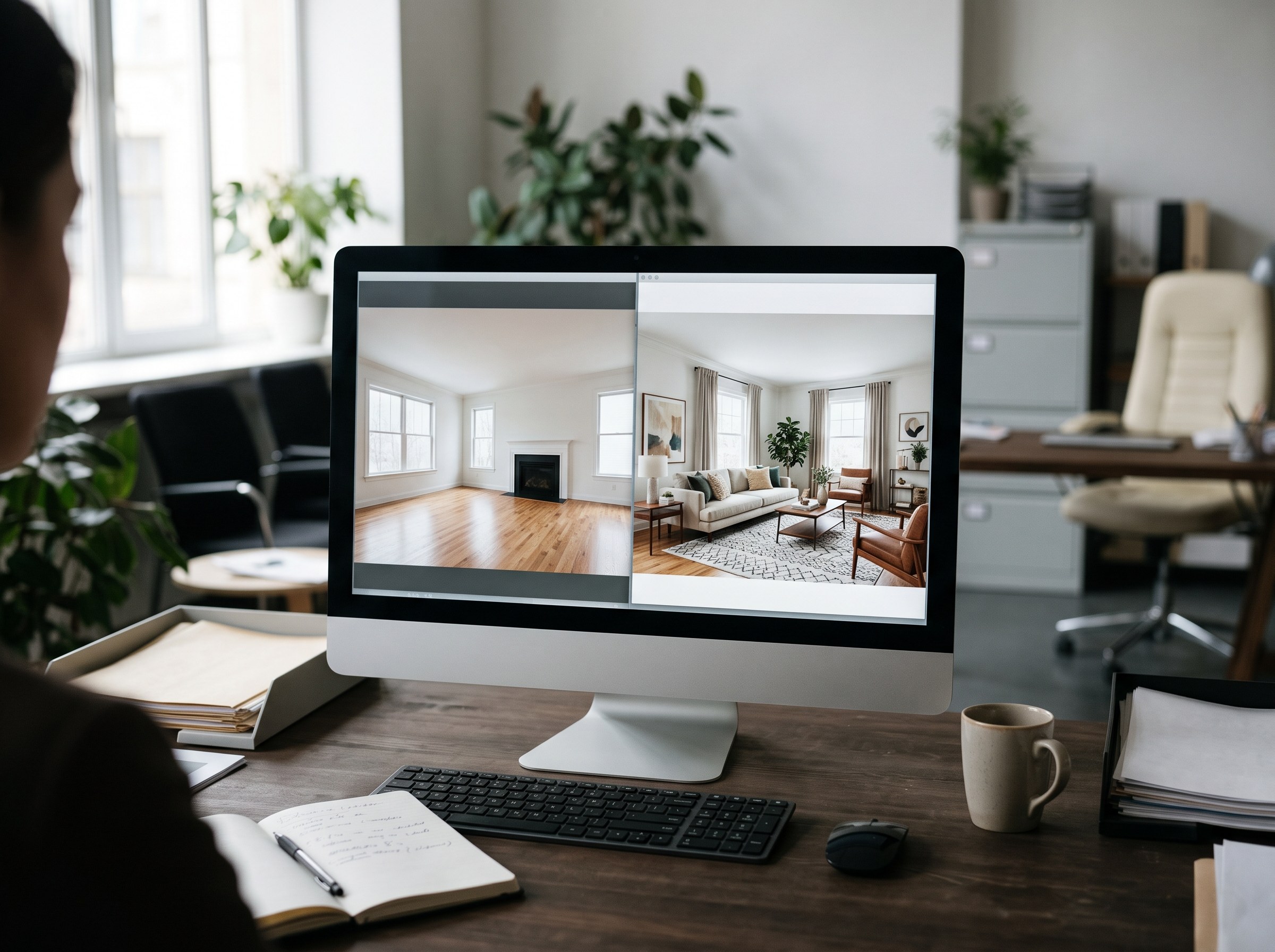
AI Virtual Staging vs Virtual Staging Services: Cost, Speed and Quality
Virtual staging services charge $16 to $34 per photo; an AI app costs $1 or less per attempt. Real vendor prices, a real three-attempt test and when each wins.
9 min read

Real Estate Listing Video From Photos: 3 Formats Compared
Make a real estate listing video from photos alone: Video Transition, Video Walkthrough and House Tour compared, with real outputs, credit costs and limits.
9 min read
Does Virtual Staging Help Homes Sell Faster? The Data
Staging is linked to faster sales in NAR's agent survey, but no public study isolates virtual staging's effect on days on market. What the data proves, what it doesn't, and a real before and after.
9 min read