AI Virtual Staging vs Virtual Staging Services: Cost, Speed and Quality
 David Sirera
 The short answer: for most empty-room listing photos, an AI virtual staging app is the better buy. It costs well under a dollar per attempt instead of $16 to $34 per photo, and you get the result in about a minute instead of the next business day. A virtual staging service is still worth paying for when the edit is complex, when you want a person to own the revisions, or when you have no time to check every photo yourself. RoomLab.app is the AI option we build, so below you will find the services' own published prices, a real test of our tool on one empty room, including the attempts we would not use, and a simple rule for choosing.
RoomLab.app is our own product. That is why every competitor price in this article is copied from the vendor's own page, dated, and why the test shows all three of our attempts rather than the best one alone.
Key takeaways
- Services: $16 to $34 per photo on the vendors' own price pages (Styldod, VRX Staging, PadStyler), or €30 at BoxBrownie, with delivery in 12 to 48 hours and free revisions (as of October 2026).
- AI apps: RoomLab.app charges 10 credits per staged image, which works out to about $0.33 to $1.00 per attempt depending on the plan, and returns it in about a minute.
- The catch with AI: you are the quality check. In our test, 1 of 3 attempts kept every permanent feature; the other 2 swapped the ceiling light. Each retry costs another attempt.
- The catch with services: you wait, and the base fee per photo is the same whether the room is easy or hard. You do get a person who fixes mistakes for you.
- Rule of thumb: AI for empty rooms, quick turnarounds and trying several styles. A service for occupied rooms with heavy furniture removal, renovation-style edits or a high-end listing where you want someone else to own the result.

What is the difference between a virtual staging service and an AI virtual staging app?
The difference is who does the work and how you pay for it. With a virtual staging service, you upload your photos to a company, choose a style, and its team returns the staged images, usually within one or two days. You pay per photo, and if something is wrong you ask for a revision. With an AI virtual staging app, you upload the photo, pick a style, and software generates the staged room while you wait. You pay per attempt, usually through credits or a subscription, and if something is wrong you try again or fix it yourself.
The line between the two is blurring. Several companies that started as editing services now sell AI staging as well: PadStyler lists its designer-made "Bespoke" staging next to AI plans on the same pricing page, and PhotoUp's virtual staging page now leads with AI. So the real choice is not between brands, it is between two ways of working: paying for a finished photo, or paying for fast attempts that you approve yourself.
How much do virtual staging services cost compared with AI?
Human virtual staging services charge between $16 and $34 per photo on their own pricing pages, and AI costs a fraction of that per attempt. The table shows what each vendor published when we checked on October 12, 2026. Prices change, so verify with the vendor before you order.
| Option | Price per photo | Turnaround | Revisions | Furniture removal |
|---|---|---|---|---|
| RoomLab.app (AI app, our product) | 10 credits per attempt: about $0.33 to $1.00 | About a minute | You regenerate; each attempt costs 10 credits | Empty Room tool, 10 credits |
| Styldod | $23, or $16 for 8+ images | 24 to 48 hours; 12 hours for +$12 | Unlimited free revisions | From $15 |
| VRX Staging | $29 | Next business day | Unlimited revisions | $55 for removal plus staging |
| PadStyler Bespoke | $34 for 1 photo, down to $23 for 8+ | Under 24 hours | Unlimited until satisfied | Not priced separately |
| BoxBrownie | €30 (shown to us in euros) | 48 hours | Free changes within two months (EU site) | €5 to €10 |
Sources: vendor pages for Styldod, VRX Staging, PadStyler, BoxBrownie, as of October 2026. BoxBrownie showed us its European site, so its price may differ in your country. RoomLab.app range: Premium subscription ($99 a month for 3,000 credits) to the one-time Personal pack ($15 for 150 credits), US dollar prices.
Those numbers sit inside the range an AI staging vendor gave in a 2024 sponsored post on the REALTOR® Magazine site, which said traditional virtual staging companies "typically charge around $10 to $50 per photo" (Source, 2024). Note that this is a vendor's paid article, not NAR research, which is why we checked the services' own pages instead.
The per-attempt figure flatters AI a little, and it is fair to say so. A service price is for a finished, revised photo. An AI price is for one try. If you need three tries to get a photo you are happy with, as we did in the test below, the real cost on the Pro plan is $1.50, still about a fifteenth of the cheapest single-photo service price. For a 10-photo listing, that is roughly $15 against $160 to $290 at the services' bulk or standard rates. Cost per photo also matters more than it looks, because the services charge the same for an easy empty bedroom as for a hard open-plan space. For the bigger picture against hiring furniture, see our comparison of virtual staging vs physical staging.
Which is faster: a staging company or AI?
AI, by a wide margin. The services we checked promise 12 hours at best, at an extra $12 per image with Styldod, and 24 to 48 hours as standard. An AI app returns each attempt in about a minute, so you can stage a whole listing in one sitting, see the result, and change the style before the photographer has left. That matters most when a listing goes live tomorrow, when a seller wants to see two styles before choosing, or when you are pitching for a listing and want to show what the empty rooms could look like.
Speed has a hidden cost, though: the time you spend checking. A service hands you a photo that someone has already looked at. With an app, the checking is your job, and it takes a minute or two per photo to do properly.
Is AI virtual staging as good as a human virtual stager?
For a typical empty room, the best AI results are good enough for a listing, but not every attempt is, and that is the honest difference. A good human stager gets the room right the first time and fixes it when asked. An AI app gives you a strong result often and a flawed one sometimes, and you have to spot which is which. We ran a test to show what that looks like.
Our test: one empty living room, three attempts
We started from an example photo of an empty apartment living room: grey laminate floor, a radiator under the window, a glazed balcony door, a doorway to the hall and a plain round ceiling light. It is an example photo made for this test, not a customer's listing. We ran it through the Virtual Staging tool three times with the same settings, Scandinavian style and room type living room, and kept every output unretouched.
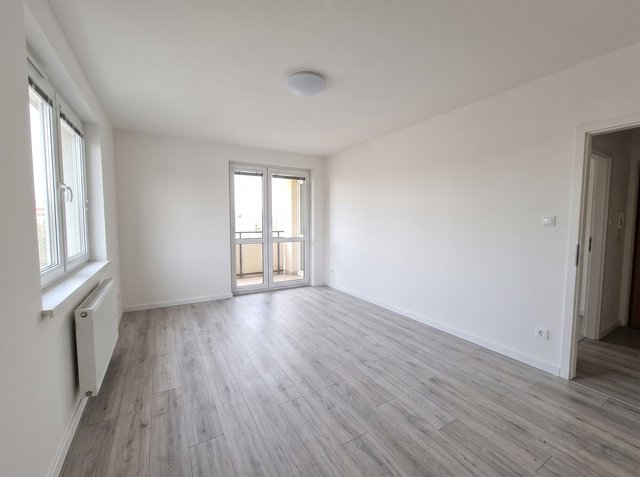
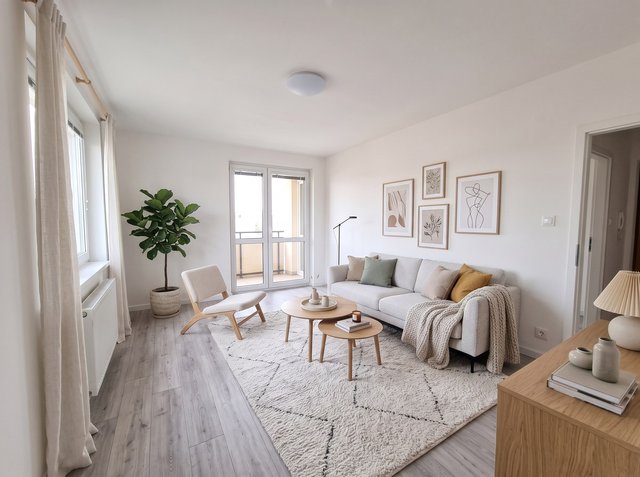
What held in attempt 1: the camera angle, the window, the radiator, the balcony door, the doorway, the light switch and the round ceiling light all match the original. The sofa sits along the long wall with a clear path from the hall to the balcony door, and the pieces are in proportion to a small apartment. We would put this photo on a listing, labelled as virtually staged.
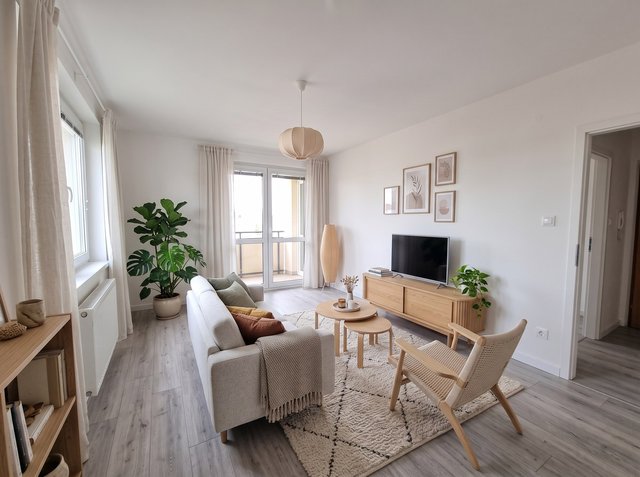
The limitation: attempt 2 has well-chosen furniture, but it replaced the flush ceiling light with a paper pendant shade. Attempt 3, not shown, swapped the same light for a wood-rimmed one. A buyer would notice either at a viewing. So in this test 1 of 3 attempts was listing-ready, and the other two would have needed a retry or a retouch.
This is the trade in one room. A service would have charged $23 to $34 for one photo in US dollars, or €30 at BoxBrownie, and corrected the light if we asked. The app charged three attempts, about $1.50 on the Pro plan, and left the checking to us. One test room is not a measured failure rate, but the kind of mistake matches what we see elsewhere: in the examples we have published, AI staging changes small fixed features, like light fittings, outlets and switches, more often than walls or windows. Our article on whether virtual staging helps homes sell faster shows another example, a dining room that gained a pendant light. Compare every output with the original before you use it, and see our guide on whether virtual staging is legal for how to label staged photos.
When is a virtual staging service still the better choice?
Pay a service when the edit is hard, the stakes are high or your time is worth more than the fee. Specifically:
- Occupied rooms full of furniture. Removing a lived-in room's furniture and then staging it is where a human editor is most reliable. RoomLab.app can do it in two steps, Empty Room and then Virtual Staging, but heavily furnished rooms give the AI more to reconstruct, and it is more likely to drift.
- Renovation-style edits. New flooring, repainted walls, a redesigned kitchen. Services often sell these as separate products. AI tools can do them, but on a listing they need disclosure as edits, not just staging.
- High-end listings with a style brief. If the seller wants specific furniture, a consistent look across 25 photos and a designer's eye, a person following a brief is easier to direct than prompts.
- You do not want to check the photos. If you will not compare each output with the original, pay someone who will. Publishing an AI photo that moved a light fitting costs more trust than the fee you saved.
Vendor details for individual services and apps are in our roundups of AI virtual staging software, real estate photo enhancement tools and room declutter apps.
Are virtual staging apps better than virtual staging services for real estate listings?
For most empty-room listings, yes: an app gives you a usable staged photo for a small fraction of the cost and the same day, as long as you check every result. Use this as a quick decision guide.
| Your situation | Better choice | Why |
|---|---|---|
| Vacant home, listing goes live this week | AI app | Minutes, not days, at a fraction of the cost |
| Seller wants to see two or three styles | AI app | Each extra style is one more attempt, not another order |
| Many listings a month on a tight budget | AI app | Per-photo service fees add up fast |
| Occupied rooms with lots of furniture to remove | Service | Complex removal is where human editors are most reliable |
| Luxury listing with a detailed style brief | Service | A person follows a brief and keeps 25 photos consistent |
| No time to review every photo | Service | Someone else does the quality check and the revisions |
Many agents end up using both: an app for everyday vacant listings and for showing sellers what is possible, and a service for the occasional complex or premium job. Agents who stage every listing can see the full workflow on our real estate staging page.
How do you get service-level results from an AI staging app?
Act as your own editor. Here is the process we use in RoomLab.app:
- Start with a good photo. Daylight, lights on, camera at chest height from a corner, horizontal lines straight. The staging cannot fix a dark or tilted shot.
- Open the RoomLab.app workspace, choose Virtual Staging, set the room type and pick a style that suits the likely buyer. Neutral styles such as Modern or Scandinavian are the safe default.
- Check the permanent features. Walls, floor, windows, doors, radiators, switches and fixed lighting should match the original exactly. The ceiling light is the one to watch, as our test showed.
- Retry, do not settle. If something permanent changed, generate again. Budget two or three attempts for a tricky room, which is still far below a service fee.
- Empty first if the room is furnished. Use Empty Room, check it, then stage the empty result. Use Declutter Room instead if you only need to clear small items and keep the furniture.
- Label the photo and keep the original. Caption it as virtually staged and keep the empty version for anyone who asks.
Frequently asked questions
How much does a virtual staging service cost per photo?
On the vendors' own pages in October 2026, Styldod charged $23 per image ($16 for 8 or more), VRX Staging $29, PadStyler's Bespoke service $23 to $34 depending on volume, and BoxBrownie €30. Faster delivery and furniture removal cost extra.
How much does AI virtual staging cost?
It depends on the app and plan. PadStyler's AI plans, for example, list $0.65 to $2.65 per photo (as of October 2026). In RoomLab.app a staged image costs 10 credits, which is about $0.33 to $1.00 per attempt in US dollars depending on the plan. Every new account gets one free image, no card required.
Can buyers tell AI virtual staging from a human stager's work?
Not from a good result: both produce a photorealistic staged room. What gives AI away is mistakes, such as a changed light fitting, a missing outlet or furniture out of scale. Check every output against the original and regenerate anything that changed a permanent feature.
Do virtual staging services use AI now?
Some do. PadStyler sells designer-made staging and AI plans side by side, and PhotoUp's virtual staging page now leads with AI. If you are paying for human work, check which product you are ordering.
The bottom line
Virtual staging services sell a finished, revised photo for $16 to $34 and a wait of 12 to 48 hours. AI apps sell fast attempts for about a dollar or less each and make you the editor. For empty rooms and tight deadlines, the app wins on cost and speed as long as you check every output, as our three-attempt test shows. For complex removals, premium listings or when you cannot review the photos yourself, a service is still worth the fee. Your first RoomLab.app image is free, no card required, so you can stage one empty room and compare it with a service quote before you spend anything.
Sources
- Styldod, Virtual Staging pricing, retrieved 2026-10-12.
- VRX Staging, Virtual Staging product page, retrieved 2026-10-12.
- PadStyler, Purchase page (Bespoke and AI plans), retrieved 2026-10-12.
- BoxBrownie, Virtual Staging and Pricing (European site, EUR), retrieved 2026-10-12.
- PhotoUp, Virtual Staging, retrieved 2026-10-12.
- AI HomeDesign, sponsored post on REALTOR® Magazine, Generative AI Is Your Ally for Smart Staging, July 2024 (vendor content, not NAR research).
Ready to Transform Your Space?
Start creating stunning room transformations in minutes. Sign up and try it yourself!
More Articles

Real Estate Listing Video From Photos: 3 Formats Compared
Make a real estate listing video from photos alone: Video Transition, Video Walkthrough and House Tour compared, with real outputs, credit costs and limits.
9 min read

Does Virtual Staging Help Homes Sell Faster? The Data
Staging is linked to faster sales in NAR's agent survey, but no public study isolates virtual staging's effect on days on market. What the data proves, what it doesn't, and a real before and after.
9 min read
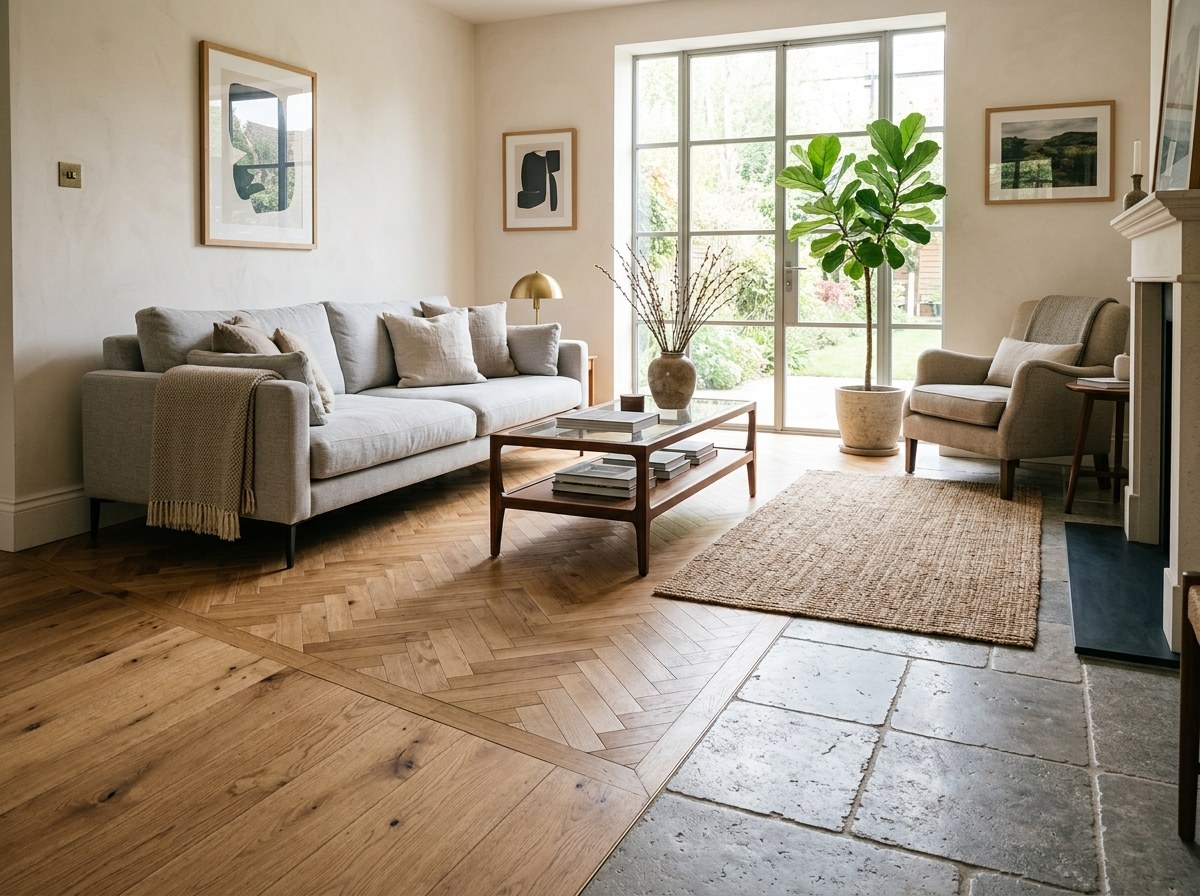
How to Change the Flooring in a Photo of Your Room
Upload a photo of your room and a photo of any flooring sample, and RoomLab.app lays the new floor into your real room. Step-by-step guide with two real before and after examples and the limits to check.
8 min read