How Much Does Home Staging Cost in 2026?
 David Sirera
The short answer: in the US, the median cost of home staging was $1,500 when sellers' agents used a staging service, and $500 when the agent staged the home themselves, according to the National Association of Realtors (NAR 2025 Profile of Home Staging). Cost guides put most projects between $1,000 and $3,000, but staging an empty house with rented furniture typically runs $4,000 to $6,000 (Fixr, 2025). If the rooms only need to look furnished in the listing photos, you can stage them in RoomLab.app for 10 credits per image, which is $0.33 to $1.00 per image depending on the plan.
This guide breaks the price down the way stagers quote it: the consultation, the per-room fee, monthly furniture rental and the minimum contract. It shows why a vacant home costs several times more than an occupied one, who usually pays, and the cheaper ways to stage a house when the full quote is out of reach. Agents who stage listings every week can see the whole workflow on our real estate staging page.
Key takeaways
- Median cost: $1,500 for a staging service and $500 when the seller's agent stages the home, in NAR's survey of 1,266 Realtors (NAR, 2025).
- Vacant costs more: staging an occupied home typically costs $1,000 to $3,000, an empty one $4,000 to $6,000, because every room needs rented furniture (Fixr, 2025).
- The monthly fee is the hidden cost: furniture rental is billed per month, and many contracts have a minimum of one to three months even if the home sells in a week (Colibri Real Estate, 2026).
- Who pays varies: 23% of sellers' agents said they personally offer to stage the home, 17% said the seller pays, and 26% said it depends (NAR, 2025).
- Cheaper routes exist: a consultation only, staging just the living room, or virtually staging the listing photos for a fraction of the price.
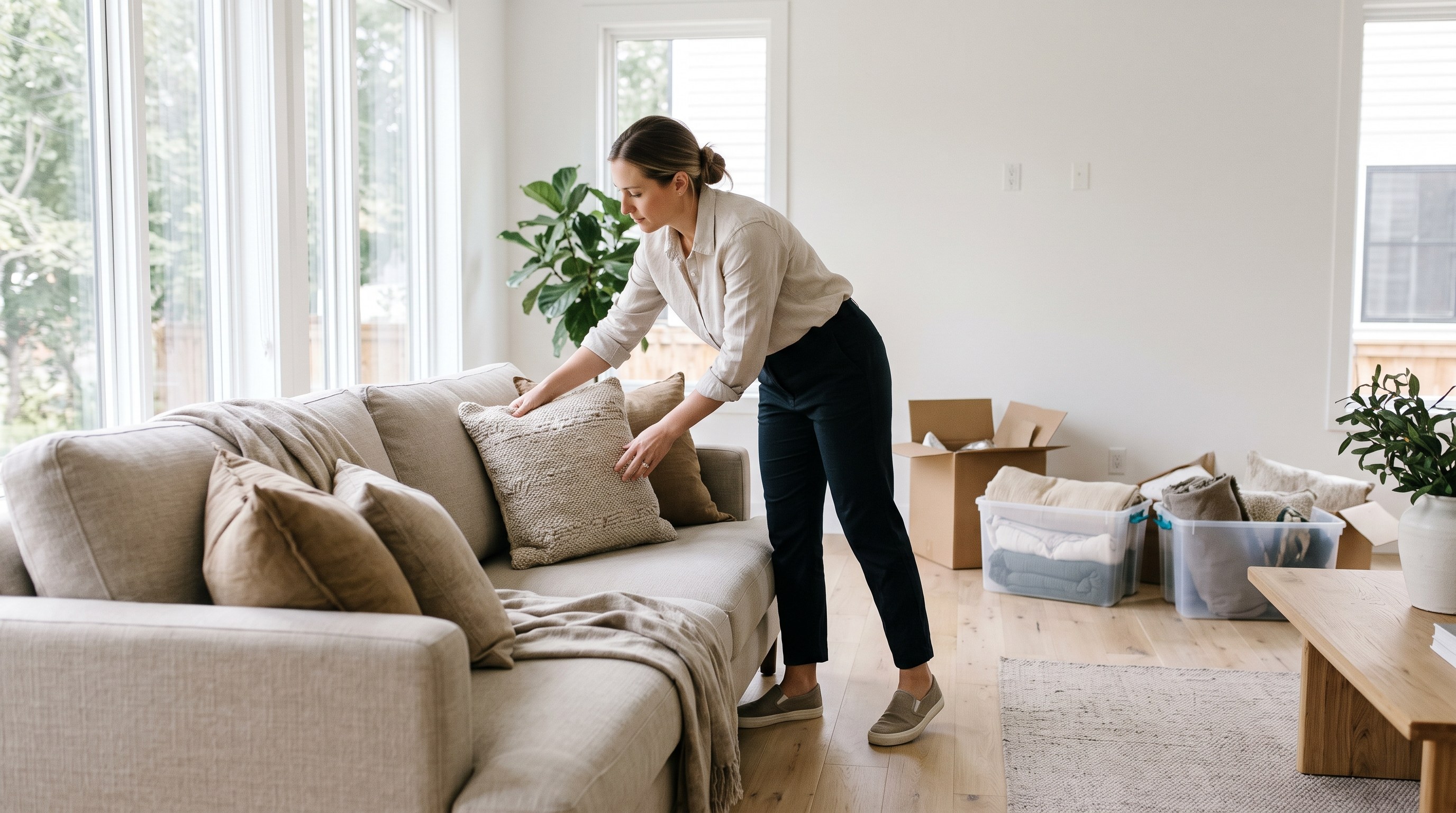
How much does home staging cost in 2026?
Expect about $1,500 for professional staging, with most projects between $1,000 and $3,000. The most reliable number comes from NAR's 2025 Profile of Home Staging. In February 2025 NAR surveyed a random sample of active Realtors and got 1,266 usable responses. It found that "the median cost for using a staging service was $1,500, compared to $500 when the home sellers' agent handled the staging themselves" (NAR, 2025). A median is the middle quote, so half of the staging jobs in the survey cost more and half cost less.
Cost guides land in the same place. Fixr gives a national range of $1,000 to $3,000 with an average of $1,500, and says that average covers "an initial consultation, a day of staging, and no furniture rental". Full-service staging of about four rooms with rented furniture runs $4,000 to $10,000 (Fixr, updated January 2025). Fixr does not publish how it collects its figures, so read them as ballpark prices rather than survey results.
You will also see "up to $2,800" quoted for physical staging. That figure comes from a sponsored post by an AI staging vendor on nar.realtor, not from NAR research, and it gives no method (sponsored post on nar.realtor, 2024).
Here is what each part of a staging quote typically costs, according to Fixr's guide:
| Service | What you get | Typical cost |
|---|---|---|
| Consultation only | A walkthrough with a written or verbal list of changes you make yourself | $200 to $500 |
| Furniture arrangement | The stager rearranges furniture already in the room | $250 to $350 per room |
| Decluttering, packing and storage | Help clearing the home before photos and showings | $500 to $1,000 |
| Occupied home staging | Your furniture, rearranged and topped up with accessories | $1,000 to $3,000 |
| Empty home staging | Rented furniture and decor for a vacant home | $4,000 to $6,000 |
| Full-service staging | Consultation, rental furniture and redesign, usually about four rooms | $4,000 to $10,000 |
Source: Fixr home staging cost guide, updated January 2025. National ranges; local quotes vary.
How much do stagers charge per room?
Arranging a room costs about $250 to $350, and renting furniture for it costs a few hundred dollars a month. Fixr puts furniture arrangement at $250 to $350 per room. Its rental estimates run $200 to $700 a month for a living room (sofa, chairs, art) and $250 to $700 for a bedroom (bed, drawers, art), with offices and kitchens cheaper at $50 to $300 (Fixr, 2025). One summary table on the same page lists rental at "$50 - $70 /room and month", which contradicts its own room-by-room table, so ask your stager for a room-by-room rental quote rather than relying on a per-room average.
Bedrooms and living rooms cost the most because they need the largest pieces. They are also the rooms agents stage most. The living room was the most commonly staged room, named by 91% of sellers' agents, followed by the primary bedroom at 83% (NAR, 2025). If you are pricing a partial job, those two rooms are where the money goes.
How much does it cost to stage a house by size?
A typical three-bedroom house costs about $1,500 to $2,500 to stage if you live there, and $4,500 to $5,500 if it is empty (Fixr, 2025). The number of bedrooms matters because bedrooms are the most expensive rooms to furnish, so each one you add raises the quote. The gap between occupied and empty stays at several thousand dollars at every size:
Some stagers price by square footage instead. Colibri Real Estate's guide gives $800 to $1,500 for homes under 1,500 sq. ft., $1,500 to $3,000 for 1,500 to 2,500 sq. ft., $3,000 to $6,000 for 2,500 to 4,000 sq. ft., and $6,000 or more for luxury homes over 4,000 sq. ft. (Colibri Real Estate, July 2026). It notes these estimates "can vary depending on your market, the amount of furniture needed, and how long the home remains staged".
Why does staging an empty house cost more?
Because in an empty house the stager supplies everything. In an occupied home they work mostly with the seller's own furniture: they edit it, rearrange it and add accessories. In a vacant home every sofa, bed, rug, lamp and piece of art is rented, delivered, set up and later collected. Fixr estimates that staging an empty home costs around $1,000 to $3,000 more per month in furniture rental than staging an occupied one (Fixr, 2025).
That makes an occupied home the cheaper case, but the work shifts to the seller, who has to pack, declutter and keep the house show-ready while living in it. Our guide to occupied home staging covers that room by room.
How much does home staging cost per month?
Furniture rental is billed by the month, and most contracts start with a minimum term. Fixr says companies "usually offer rental periods of 45 to 60 days, after which rental may continue if the homeowner pays an additional fee" (Fixr, 2025). Colibri Real Estate says many contracts include a minimum rental period "often around one to three months", and that "if the home sells quickly, the seller may still be responsible for the minimum contract period" (Colibri Real Estate, 2026).
This is the part of a staging quote that surprises sellers. A low first-month quote can grow if the listing sits, and a fast sale does not always bring a refund. Before you sign, ask:
- How long is the minimum term, and what does each extra month cost after it?
- Are delivery, setup and pickup included, or billed separately?
- Which rooms and which pieces does the quote cover?
- Who is responsible if a rented piece is damaged during a showing?
- Can you remove furniture early if the home goes under contract?
Do most realtors pay for staging?
Many do, but there is no standard rule. When NAR asked sellers' agents about staging compensation, "26% of home sellers' agents said it depends on the situation. Another 23% reported that they personally offer to stage the home, and 17% said that the seller pays to stage the home before listing" (NAR, 2025). The release does not report how the remaining agents answered, so those three numbers are not the full picture.
Staging is also less universal than it looks. Only 21% of sellers' agents said they stage all their sellers' homes before listing, 10% stage only homes that are difficult to sell, and 51% did not stage at all but recommended that sellers declutter or correct property faults (NAR, 2025). If your agent offers staging, ask whether it is included in their commission or billed to you, and get the answer in writing.
Is home staging worth the cost?
Agents largely think so, though the evidence is their opinion rather than measured sales. In NAR's 2025 survey, 83% of buyers' agents said staging made it easier for buyers to picture the property as their future home, 49% of sellers' agents saw staging reduce time on market, and 29% reported a 1% to 10% increase in the dollar value offered compared with similar unstaged homes (NAR, 2025).
To weigh that against a $1,500 median bill, compare the possible price gain with the cost of the listing sitting another month: mortgage, taxes, utilities and, for a vacant home, another month of furniture rental. We cover what the data does and does not show about staging and time on market in does virtual staging help homes sell faster.
What is the cheapest way to stage a house?
Start with what costs nothing, then pay only for the rooms and the photos that matter most. From cheapest to most expensive:
- Declutter and clean yourself. Decluttering was the improvement agents recommended to sellers most often, ahead of cleaning the entire home (NAR, 2025). It costs time, not money.
- Pay for a consultation only. A stager walks through and tells you what to move, remove or buy, for about $200 to $500 (Fixr, 2025).
- Ask your agent. The median cost was $500 when the seller's agent handled staging, a third of the median for a staging service (NAR, 2025).
- Stage the key rooms only. Rent furniture for the living room and primary bedroom and leave the guest rooms empty. Guest bedrooms and children's bedrooms were the least staged rooms, at 22% each (NAR, 2025).
- Virtually stage the listing photos. Buyers see furnished rooms online, and the house stays empty for showings. It costs the least by far, but it only changes the photos.
Virtual staging fits best when the home is vacant, which is exactly when physical staging is most expensive. In RoomLab.app, the Virtual Staging tool costs 10 credits per image: about $1.00 with the one-time Personal pack ($15 for 150 credits) and down to about $0.33 on the largest monthly plan (USD, as of October 2026). For a full head-to-head on cost, speed and in-person showings, see virtual staging vs physical staging.
Our test: one empty living room, three attempts
To show what virtual staging does to an empty room, we made an example photo of a vacant 1990s living room: beige carpet, gray walls, a brick fireplace, a brass ceiling fan and an opening to the hallway. We ran it through Virtual Staging three times with the room type set to Living Room and the Modern style. Here is the original next to the best attempt, unretouched. This is an example photo, not a customer's home.
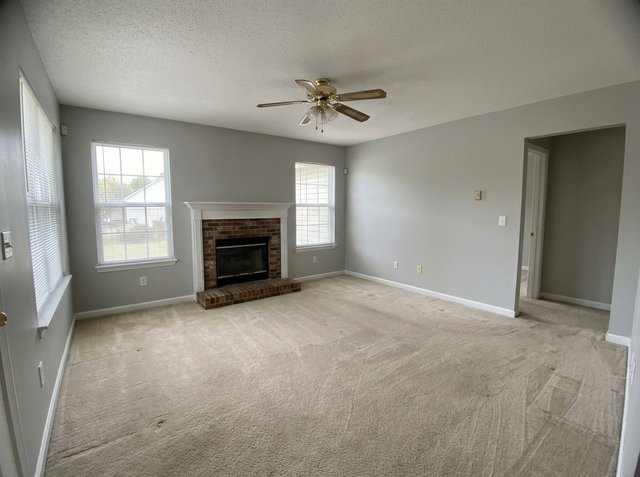
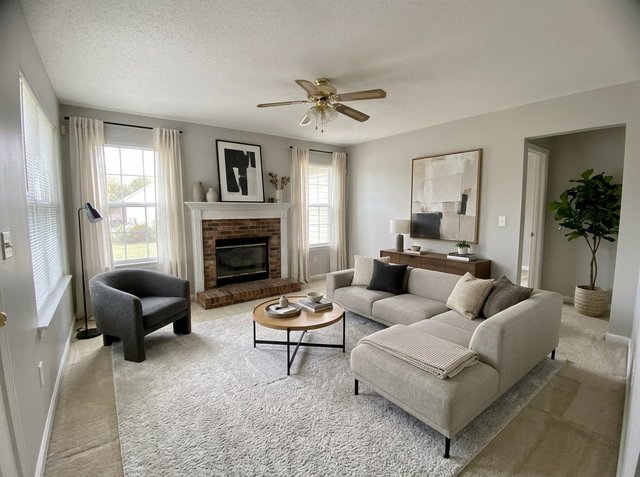
What held in attempt 1: the camera angle, the beige carpet, the brick fireplace and mantel, both windows, the blinds on the side window, the hallway opening, the brass ceiling fan, the outlets and the light switches all match the original. The sectional leaves the walkway to the hallway clear. A physical stager would bring the same kind of pieces: a sofa, a chair, a coffee table, a rug, lighting, art and a plant.
What did not: attempts 2 and 3 staged the room just as well, but both replaced the beige carpet with light hardwood and swapped the brass ceiling fan for a black one. In a listing, that misrepresents the house: a buyer who falls for the wood floor will find carpet at the showing. Before you publish a virtually staged photo, compare it with the original and keep only results where nothing permanent changed.
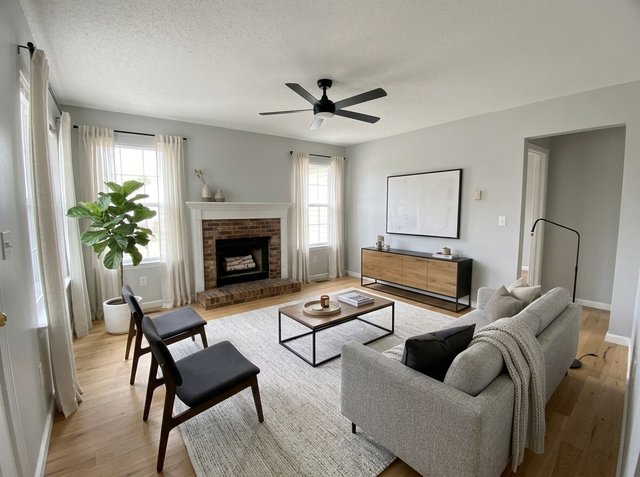
Three attempts cost 30 credits, about $3 on the Personal pack. Disclosure rules vary: in California, AI-altered listing photos must be labelled with terms such as "virtually staged" and the original photo included since January 1, 2026 (CRMLS), so check your MLS. Our guide on whether virtual staging is legal covers disclosure.
How to virtually stage a room in RoomLab.app
- Photograph the empty room in daylight, from a corner, at chest height, with the lights on.
- Open the RoomLab.app workspace, upload the photo and choose Virtual Staging.
- Pick the room type and a style, then generate.
- Compare the result with the original: floors, walls, windows, doors and fixtures must be unchanged. Generate again if anything permanent moved.
- Label the photo as virtually staged in the listing.
Virtual staging has one clear limit: it does nothing for the in-person showing. Buyers who visit still walk into an empty room. For a high-end vacant home with heavy foot traffic, physical staging can still be worth the monthly fee.
Frequently asked questions
How much does it cost to stage an empty house?
Typically $4,000 to $6,000, against $1,000 to $3,000 for an occupied home, according to Fixr's 2025 cost guide. The difference is the rented furniture, which is billed monthly, often with a minimum term of one to three months.
How much do stagers charge for a consultation?
Usually $200 to $500 for a walkthrough and a list of changes you make yourself (Fixr, 2025). Colibri Real Estate gives a wider $150 to $600, depending on the market and the size of the home (2026).
Who pays for home staging, the seller or the agent?
It varies. In NAR's 2025 survey, 23% of sellers' agents said they personally offer to stage the home, 17% said the seller pays, and 26% said it depends on the situation. Agree on it before you sign the listing agreement.
Is virtual staging cheaper than physical staging?
Yes, by a wide margin. RoomLab.app's Virtual Staging costs about $0.33 to $1.00 per image (USD, as of October 2026), against a $1,500 median for a staging service (NAR, 2025). It only changes the listing photos, so buyers still tour an empty home.
The bottom line
Budget about $1,500 for a staging service, $500 if your agent does it, and $4,000 or more if the home is empty and every room needs rented furniture. Read the contract for the minimum term and the monthly fee, because that is where staging bills grow. If the house is vacant and the listing photos are what you need, virtual staging gives buyers furnished rooms online for a few dollars. Your first RoomLab.app image is free, no card required, so you can stage one room and compare it with a stager's quote before you spend anything.
Sources
- National Association of Realtors, NAR Report Reveals Home Staging Boosts Sale Prices and Reduces Time on Market (2025 Profile of Home Staging, n=1,266), retrieved 2026-10-23.
- Fixr, Cost to Stage a Home (updated January 31, 2025), retrieved 2026-10-23.
- Colibri Real Estate, Home Staging Costs: Complete Guide for Real Estate Agents (July 1, 2026), retrieved 2026-10-23.
- California Regional MLS, California's Altered Image Law (CA AB 723) FAQs, retrieved 2026-10-21.
- REALTOR Magazine, Styled, Staged & Sold, Generative AI Is Your Ally for Smart Staging, Faster Deals (sponsored post by AI HomeDesign, July 2024), retrieved 2026-10-23.
Ready to Transform Your Space?
Start creating stunning room transformations in minutes. Sign up and try it yourself!
More Articles
Best Bathroom Remodel Visualizer Apps (2026)
We compared 7 bathroom visualizers, from Daltile and MSI to Planner 5D. RoomLab.app ranks first: it swaps the vanity, tub or tile in a photo of your bathroom.
10 min read
Occupied Home Staging: How to Stage a Home You Still Live In
How to stage a house you still live in: what to pack, a room-by-room plan, a daily show-ready routine, and a real test of decluttering listing photos with AI.
10 min read
AI Virtual Staging vs Virtual Staging Services: Cost, Speed and Quality
Virtual staging services charge $16 to $34 per photo; an AI app costs $1 or less per attempt. Real vendor prices, a real three-attempt test and when each wins.
9 min read